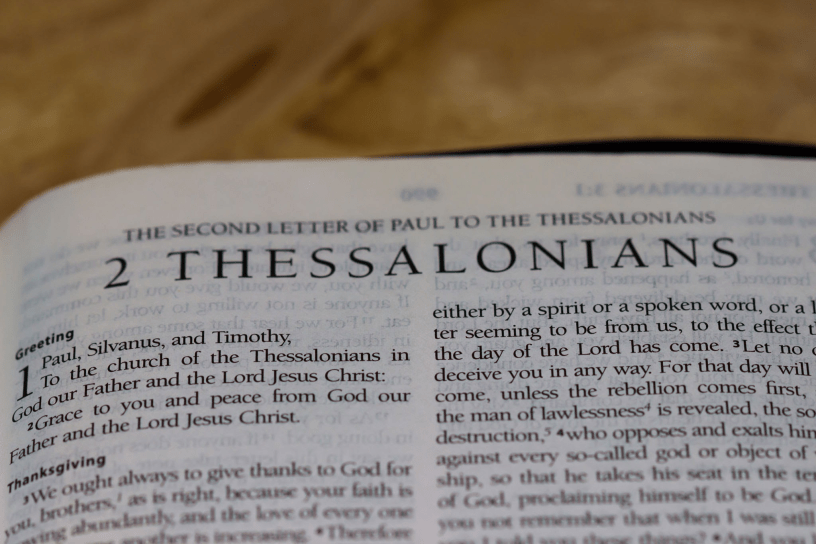
Few passages in the New Testament have generated as much theological debate, speculation, and confusion as 2 Thessalonians chapter 2.
The church in Thessalonica was deeply troubled. They had received a forged message or report claiming that the “Day of the Lord” had already come and gone, leaving them fearful that they had somehow missed Christ’s return. Paul writes to calm their fears and remind them of what he had already taught them in person: certain events must take place before that day arrives. Most notably, the “Man of Lawlessness” — often connected with the Antichrist — must first be revealed.
But according to Paul, something is currently preventing that from happening.
Paul writes in 2 Thessalonians 2:6-7:
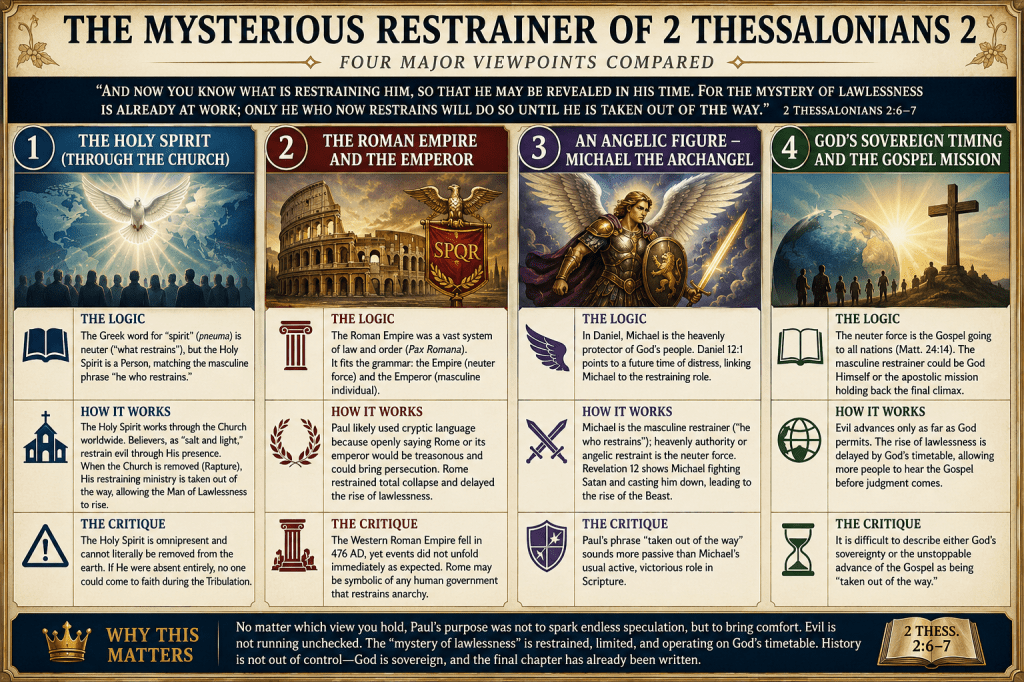
“And now you know what is restraining him, so that he may be revealed in his time. For the mystery of lawlessness is already at work; only he who now restrains will do so until he is taken out of the way.”
One fascinating detail is the shift in language. In verse 6, the restrainer is described in neuter terms — “what is restraining” — which could point to a force, system, or institution. But in verse 7, the language becomes masculine — “he who now restrains” — suggesting a personal being or individual.
Paul writes as though the Thessalonians already understood exactly who or what he meant: “And now you know…” Yet because he never clearly identifies the Restrainer in the letter, Christians have debated the mystery for centuries.
Let’s explore the four most widely held interpretations of this mysterious Restrainer.
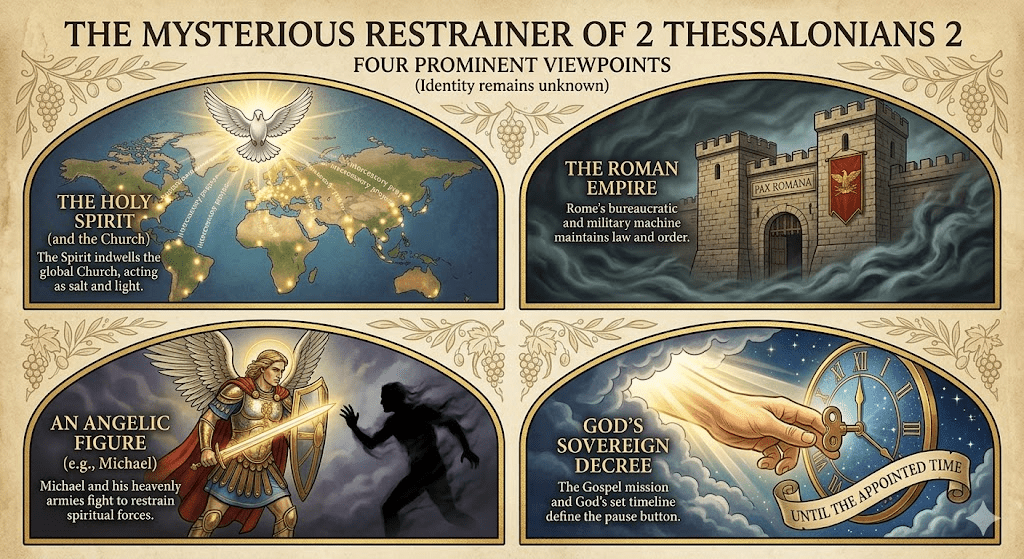
1. The Holy Spirit (Through the Church)
This is arguably the most common interpretation within modern evangelical and dispensational theology. The idea is simple: only a divine, supernatural power could restrain the full force of satanic lawlessness on a global scale.
The Logic
Supporters of this view point to the grammatical shift in the text. The Greek word for “spirit” (pneuma) is neuter, which fits Paul’s phrase “what restrains.” Yet the Holy Spirit is also personal, which aligns with the masculine phrase “he who restrains.”
How It Works
According to this interpretation, the Holy Spirit currently works through the Church scattered throughout the world. Believers serve as “salt and light,” slowing moral collapse and restraining evil through the Spirit’s presence.
When the Church is removed — often connected with the Rapture — the Holy Spirit’s unique restraining ministry is taken “out of the way,” allowing the Man of Lawlessness to rise to power.
The Critique
Critics argue that the Holy Spirit, being omnipresent, cannot literally be removed from the earth. If He were absent entirely, no one could come to faith during the Tribulation period.
2. The Roman Empire and the Emperor
For many early church fathers living under Roman rule, this interpretation made the most sense. Writers such as Tertullian and Augustine leaned heavily toward this understanding.
The Logic
The Roman Empire functioned as a massive political and military system designed to preserve order across the known world through the Pax Romana. This interpretation also fits Paul’s grammatical structure: the Empire itself was the neuter restraining force, while the Emperor was the masculine individual restraining chaos.
How It Works
Paul may have intentionally used vague language because openly discussing the downfall of Rome or its emperor could have been viewed as treasonous. Writing such things plainly could have brought severe persecution upon the church.
Under this view, Rome temporarily restrained complete societal collapse and delayed the rise of ultimate lawlessness.
The Critique
The major difficulty is historical. The Western Roman Empire fell in 476 AD, yet the events Paul described did not unfold in the immediate way many expected. Some scholars therefore view Rome more symbolically — as a representation of human government maintaining order rather than a single empire alone.
3. An Angelic Figure — Michael the Archangel
Another interpretation shifts the focus away from earthly governments and toward the unseen spiritual conflict taking place behind human history.
The Logic
In the Book of Daniel, Michael the Archangel is portrayed as the heavenly protector of God’s people. Daniel 12:1 describes a future moment connected to unprecedented distress, leading many to associate Michael with the restraining role Paul mentions.
How It Works
Under this interpretation, Michael is the masculine restrainer — “he who restrains” — while the heavenly authority or angelic restraint connected to him represents the neuter force.
This idea also connects with Revelation 12, where Michael wages war against Satan and casts him down to the earth, setting the stage for intensified evil and the rise of the Beast.
The Critique
Although this interpretation aligns strongly with Daniel and Revelation’s imagery, some argue Paul’s wording — “taken out of the way” — sounds more passive than Michael’s usual portrayal as a victorious warrior actively fighting evil.
4. God’s Sovereign Timing and the Gospel Mission
A fourth interpretation sees the Restrainer not as a single being or empire, but as God’s sovereign control over history itself.
The Logic
In this view, the neuter restraining force is the ongoing spread of the Gospel throughout the nations, connected to Jesus’ words in Matthew 24:14 that the Gospel must first be preached before the end comes.
The masculine restrainer could refer to God Himself exercising sovereign authority over history, or possibly even the apostolic mission that delayed the final culmination of events.
How It Works
Under this interpretation, evil can only advance as far as God permits. The rise of the Man of Lawlessness is delayed because God has established a precise timetable for human history and redemption.
The restraint exists because God is patiently allowing more people the opportunity to hear the Gospel before judgment arrives.
The Critique
Some scholars believe this interpretation struggles with Paul’s phrase “until he is taken out of the way,” since it feels awkward to describe either God’s sovereignty or the Gospel mission as being “removed.”
In Summary
Why This Matters
At the center of this passage is a powerful reminder: evil only moves as far as God allows.
Whether the Restrainer is understood as the Holy Spirit, human government, Michael the Archangel, or God’s sovereign timing, every interpretation ultimately points to the same truth — the rise of lawlessness is not random, unstoppable, or outside of God’s control.
Paul’s purpose in writing to the Thessalonians was not to encourage fear or endless speculation. It was to bring stability and reassurance to believers who were shaken and anxious about the future.
The “mystery of lawlessness” was already active in Paul’s day, and it is still active now. Yet Scripture presents evil as restrained, limited, and operating on borrowed time. The forces of darkness may appear powerful, but they are neither sovereign nor victorious in the end.
For Christians, this passage serves as a reminder to remain watchful without becoming consumed by fear. God has not lost control of history, and no prophetic event will unfold outside His appointed timing.
No matter which interpretation of the Restrainer someone holds, the central message remains the same: Christ will ultimately triumph, evil will be judged, and God’s kingdom will prevail.
Sealed in Christ, Copyright © 2026 by Sixth Seal Ministries. All Rights Reserved.
 Sealed in Christ